How to Find and Play Solana Games in 2026
Solana has quietly become one of the busiest homes for on-chain games. Here is a practical guide to why studios build there, the genres worth your time, how to tell a real game from a rug, and where to discover them.
Search for "Solana games" today and you will find a very different landscape than a couple of years ago. Solana's fast confirmations and low fees make it well suited to real-time genres and to games that trade assets constantly, which is exactly what on-chain economies need. The result is a broad ecosystem that spans open-world survival, strategy, arena action, and casual idle games, alongside a lot of noise. This guide is about cutting through that noise.
Why studios build games on Solana
Every on-chain action, minting an item, settling a trade, paying out a reward, is a transaction. On slower or pricier networks that friction makes real gameplay painful. Solana's design targets the opposite: sub-second confirmations and fees measured in fractions of a cent. For a game, that means an in-game marketplace can feel like a normal store, a reward can land the moment you earn it, and an item can change hands mid-session without a gas bill that dwarfs its value.
Three practical consequences follow for players:
- Real ownership. Items and currency live in your wallet, not just on a studio's server, so you can hold, trade, or move them.
- Liquid economies. Game tokens trade on Solana decentralized exchanges, so an item or currency has a visible, live market price rather than an opaque internal one.
- Portability. The same wallet works across many games and tools, so your identity and assets are not locked to a single title.
The kinds of Solana games you will find
Solana gaming is not one genre. When people picture "crypto games" they often imagine a token with a chart and nothing to actually do. The healthier end of the ecosystem looks like real games that happen to settle on-chain. Broadly, you will run into:
Open-world and survival
Larger, session-based worlds where you gather, build, fight, and trade. These are the most game-first titles on Solana, often built in full engines rather than the browser, with the token acting as the economy underneath rather than the point of the game. Fracture Labs' own Decimated sits here.
Strategy and RTS
Territory control, fleet command, and faction warfare, where owning and trading units or resources maps naturally onto on-chain assets.
Arena and action
Fast, competitive rounds where skill decides rewards. Solana's speed matters most here, because payouts and matchmaking need to feel instant.
Casual and idle
Light daily loops, tap, plant, harvest, collect, that lower the barrier to entry. These bring in players who would never install a large client, and they are a big part of Solana's day-to-day activity.
Social and creator-driven
Games built around communities, user-generated content, and social leaderboards, where engagement itself is part of the economy.
How to tell a real game from a rug
The uncomfortable truth about any fast, cheap chain is that it is just as easy to launch a scam as a game. A "rug" is a project that pulls its liquidity or dumps its supply once enough buyers are in, leaving everyone else with a worthless token. You do not need to be technical to avoid most of them. Run through this checklist before you spend anything:
- Is there an actual game? A playable build, a store page, real footage. No product, no reason to hold the token.
- Is the liquidity locked? Locked liquidity means the team cannot simply withdraw the pool and vanish. Unlocked liquidity is the single biggest red flag.
- Is the token verified? Verified tokens on Solana exchanges and trackers have passed basic checks and are less likely to be impersonators of a real project.
- Are mint and freeze authorities revoked? If a team can still mint unlimited new tokens or freeze your wallet, they hold a switch you do not want them to have.
- Is the team supply vested? Founder and team tokens on a cliff and vesting schedule mean insiders cannot race you to the exit on day one.
- Is the holder distribution sane? If a handful of wallets hold most of the supply, one of them can crash the price at will.
- Does the studio have a track record? A named team with a shipped game and a history is a very different bet than an anonymous account that appeared last week.
If a project fails several of these, it does not matter how good the chart looks. Walking away costs you nothing.
Where to discover Solana games
Finding good Solana games by scrolling social feeds is a losing game, because that is exactly where the loudest scams live. It is far better to start from a curated place that already screens for the basics above and shows you live market data in one view.
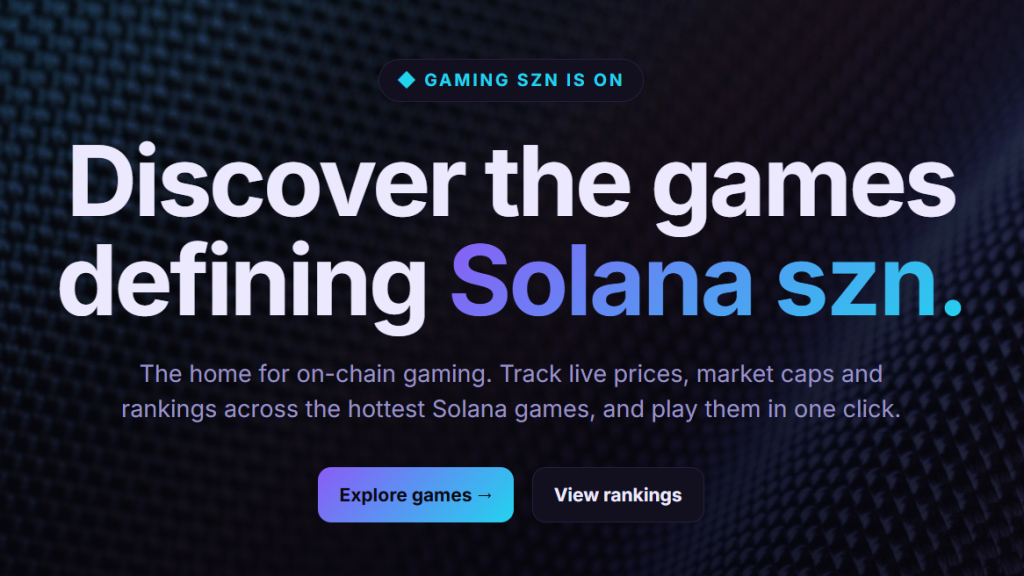
Gaming SZN: the discovery hub for Solana games
Gaming SZN is a curated hub for on-chain Solana games. It tracks a reviewed catalogue of titles with live price, market cap, 24 hour change, and volume pulled straight from Solana token markets, plus rankings, a heatmap, and a news feed that covers trending Solana tokens with risk context. The catalogue is human-reviewed and paired with an automated rug-check gate, so listed tokens carry a real trust signal rather than just a loud chart. You can browse for free and jump straight into any listed game.
Explore Solana games on Gaming SZNBeyond a curated hub, the general-purpose GameFi directories and aggregators can be useful for breadth, but treat their listings as a starting point and still run the checklist above. Discovery gets you the shortlist. The checklist decides what is worth your wallet.
Featured: Decimated
Decimated: open-world survival with a real on-chain economy
Decimated is Fracture Labs' Unreal Engine 5 open-world survival game, built around a functioning Solana economy on the DIO token. It has drawn around 400,000 alpha registrations and a 12,000 peak concurrent-user day, with a Genesis Collection of on-chain avatars and an economy where leaderboard rewards scale to real activity rather than empty emissions. It is the kind of title this guide is really about: a game first, with the token doing a job underneath it.
Getting started
If you are new to on-chain games, the ramp is shorter than it looks:
- Get a Solana wallet. A reputable self-custody wallet is enough to hold assets and connect to games. Keep your recovery phrase offline and never share it.
- Start curated. Browse a screened hub like Gaming SZN rather than random links, and use the checklist before committing anything.
- Play before you buy. The best signal is whether the game is fun and active. A healthy economy follows a healthy game, not the reverse.
- Size your risk. On-chain game tokens are volatile and some go to zero. Only commit what you are comfortable losing.
Ready to explore?
Start from a curated, rug-checked catalogue with live market data, then dive into a game worth your time.
Discover Solana games on Gaming SZNThis article is for information only. It is not financial, investment, or legal advice. On-chain game tokens are volatile and can lose all of their value. Always do your own research and only commit funds you can afford to lose.